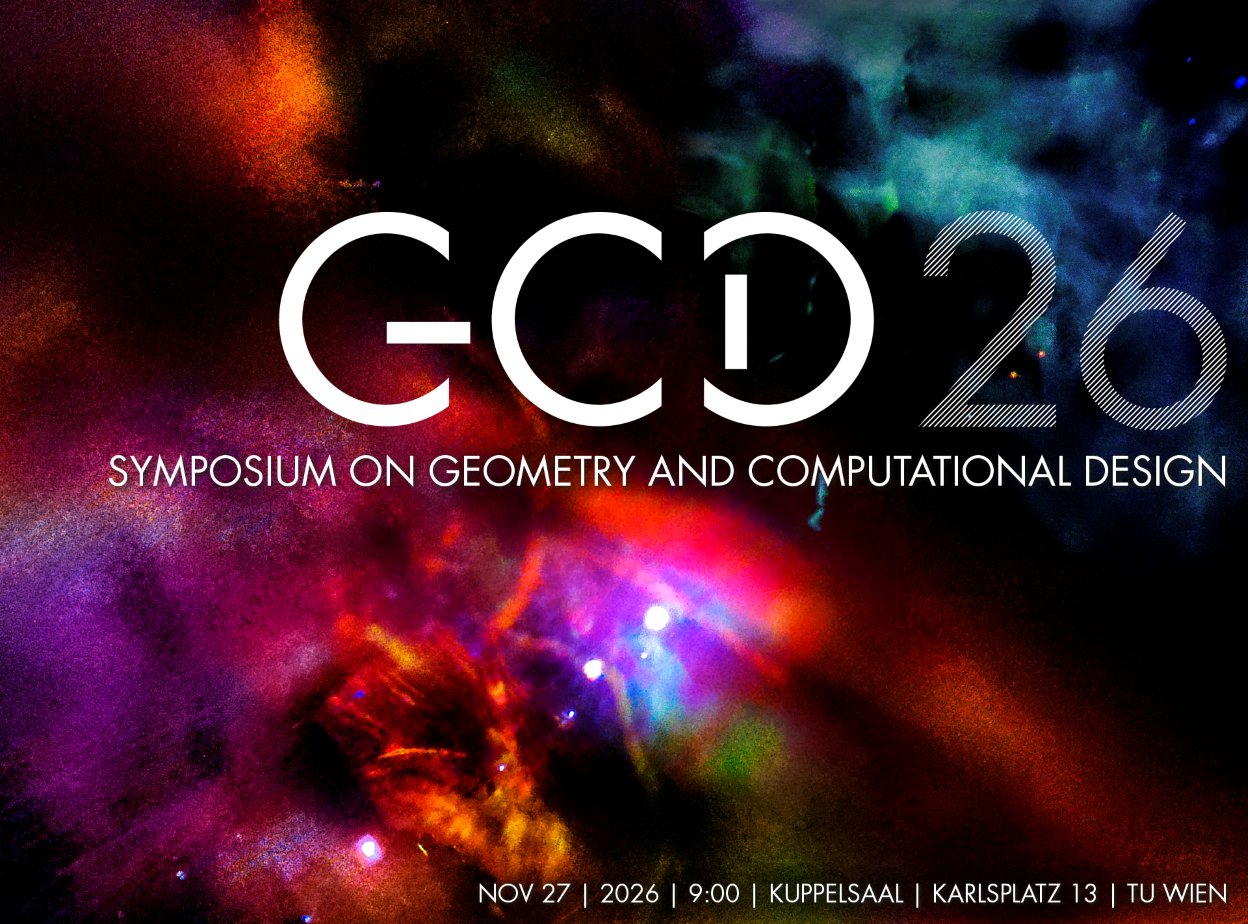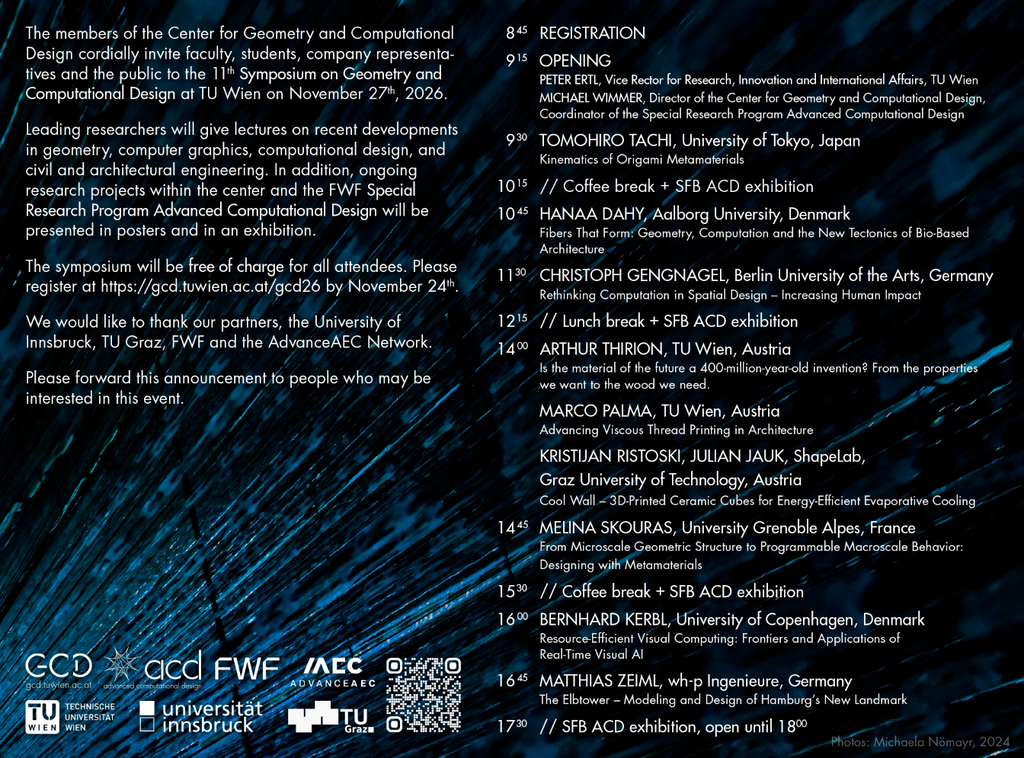





The next Symposium on Geometry and Computational Design will take place on Friday 27 November 2026 9.00 am at the Kuppelsaal, TU Wien.
Programme
8.45 Registration
9.15 Opening. Peter Ertl, Vice Rector for Research, Innovation and International Affairs. Michael Wimmer, Director of the Center for Geometry and Computational Design, coordinator of the Special Research Programme Advanced Computational Design
9.30 Tomohiro Tachi, University of Tokyo, Japan: Kinematics of Origami Metamaterials.
Some types of origami tessellations—patterns formed by arranging folded paper along lines, planes, or three-dimensional lattices—possess kinematic degrees of freedom. These structures can exhibit coordinated folding and deformation, giving rise to exotic mechanical properties; they are therefore referred to as mechanical metamaterials.
In this presentation, I first discuss the kinematics of rigid origami and use Maxwell counting to determine the degrees of freedom. I then present three types of exotic origami tessellations for which this counting fails for different reasons: overconstrained mechanisms, kinematic bifurcation, and topological mechanics. In particular, I will present recently developed aperiodic overconstrained origami mechanisms, metamaterials whose degrees of freedom and material properties can be switched through kinematic bifurcation, and origami tessellations exhibiting bulk undulation, edge modes, or solitary-wave propagation. These findings demonstrate that the behavior of origami tessellations depends strongly on their underlying geometry, raising many questions for future investigation. https://origami.c.u-tokyo.ac.jp/
10.15 Coffee break and SFB ACD Exhibition
10.45 Hanaa Dahy, Aalborg University, Denmark: Fibres That Form: Geometry, Computation and the New Tectonics of Bio-Based Architecture.
This lecture explores how material behaviour can become a generative input for geometry, computation and fabrication. Drawing on ten years of BioMat research and practice, it presents the “Materials as a Design Tool” approach as a bottom-up methodology in which renewable natural fibres, composite architectures and manufacturing constraints actively shape the design process.Through selected projects—from Tailored Fiber Placement and lightweight prototypes to pavilions, bio-based bridges, adaptive components and nature-based urban systems—the lecture demonstrates how material logic can be translated across scales into new architectural tectonics. It will also examine how computational design enables connections between material science, structural performance, fabrication, biodiversity and cultural context.Rather than treating sustainability as an additional layer applied to architecture, the lecture frames it as an intelligence embedded within geometry, material organisation and making. It concludes by outlining emerging directions for bio-based, regenerative and digitally fabricated built environments.
11.30 Christoph Gengnagel, Berlin University of the Arts, Germany: Rethinking computation in spatial design – increasing human impact
12.15 Lunch Break and SFB ACD Exhibition
13.30 Coffee Break and SFB ACD Exhibition
14.00 Arthur Thirion, GCD, TU Wien: Is the material of the future a 400-million-year-old invention? From the properties we want to the wood we need.
Wood has been optimised by evolution for 400 million years, has survived four mass extinctions, and our species’ ancestors have been building with it for nearly half a million years, notching logs together to raise themselves above the wet banks of a tributary of Lake Tanganyika.
The properties that made this possible arise from a complex hierarchical organisation of lignocellulosic material and porosity, spanning several length scales. This complexity causes significant variation in wood properties. Current industry-standard approaches treat this variability as a problem, sorting wood into broad strength classes and assuming homogeneity during design.
This work aims to enable the targeted use of wood by turning its variability into valuable information. To this end, a high-throughput multiscale modelling approach is developed, accelerated via the use of AI-based surrogate models and linked to forestry data. This enables rapid, accurate prediction of wood properties from morphological parameters and growing conditions, supporting sorting and utilisation. The longer-term goal is to reverse this flow of information, from analysing the wood we have to designing the wood we need.
Marco Palma, GCD, TU Wien: Advancing Viscous Thread Printing in Architecture.
In extrusion 3D printing, material instability is typically framed as an unwanted feature, and any physical deviation from the target toolpath geometry is suppressed through rigorous process calibration. Viscous Thread Printing (VTP) inverts this logic, harnessing Viscous Thread Instability (VTI)—the coiling of a falling viscous jet—as a generative fabrication strategy. By exploiting rather than suppressing instability, VTP enables the 3D printing of bespoke cellular ceramic structures whose porosity and geometry emerge from flow control rather than explicit toolpath definition. The talk introduces the subject and three related applications: a sensor-adaptive robotic strategy for producing functionally graded structures; a non-Newtonian simulation model for predicting printability; and an acoustic characterization of open-cell ceramic panels. Together, they aim to frame material instability not as a defect to be eliminated, but as a design driver towards performance-oriented architecture.
Kristijan Ristoski, Julian Jauk, ShapeLab, Graz University of Technology, Austria: Cool Wall – 3D-Printed Ceramic Cubes for Energy-Efficient Evaporative Cooling.
How can additive manufacturing and traditional ceramic materials contribute to cooling our built environment?
The prototype project “Cool Wall” explores 3D-printed ceramic cubes based on triply periodic minimal surface (TPMS) geometries as an energy-efficient evaporative cooling system.
By combining the ancient principle of evaporative cooling with contemporary manufacturing through 3D printing, the Cool Wall demonstrates how traditional cooling strategies can be reinterpreted for today’s built environment.
The talk presents the development from fundamental research on TPMS cooling elements to a 1:1 architectural demonstrator.
14.45 Melina Skouras, University Grenoble Alpes, France: From microscale geometric structure to programmable macroscale behavior: designing with metamaterials.
Metamaterials, i.e. materials whose macro-scale properties arise from their fine-scale geometric structure, are incredibly diverse in terms of the materials they are made of, the fabrication techniques used, and the behaviors they exhibit. They are also very useful for a wide range of applications ranging from optics, to acoustics and seismology. In this talk I will present the research I have been conducting over the last ten years on the design and modeling of metamaterials with programmable mechanical and geometrical macro-scale properties, and on their use for the computational fabrication of deformable objects.
Most of the algorithms I have developed with my collaborators rely on two-scale approaches, that first map geometric parameters of our metamaterials to their macro-scale properties, then solve an inverse problem with these properties as degrees of freedom and finally map them back to our initial geometric design parameters. I will start by presenting my work on the exploration of the space of material properties of 3D printed structures corresponding to assemblies of two base materials and their application to topology optimization problems dealing with small deformations. I will then describe my research related to the design of largely deformable objects that can be fabricated flat and be programmed to assume a 3D prescribed shape. I will show how we used our techniques to design and manufacture deployable structures made of textile and plastic strips, cardboard or inflatable membranes, showcasing the diversity of objects that can be designed using our metamaterial-based two-scale strategy.
15.30 Coffee Break and SFB ACD Exhibition
16.00 Bernhard Kerbl, University of Copenhagen, Denmark: Resource-Efficient Visual Computing: Frontiers and Applications of Real-Time Visual AI.
Modern visual computing is transforming the means and ways by which we map, understand and interact with the physical world. 3D and 4D reconstructions of real artefacts are now viable from just a handful of casual camera observations; object recognition and classification can be done with unprecedented accuracy and reliability. However, a key requirement for the overall usefulness of these methods is their efficiency: Efficiency dictates whether a solution can run in real-time; it governs the hardware requirements for execution, and wether it can be used without requiring massive, industry-grade infrastructure. Real-time performance enables crucial emerging trends, such as robots interacting with the real world, or visual AI providing on-line assistance in medical treatments on patients. Resource-efficiency, on the other hand, ensures that these breakthrough technologies can be employed by almost anyone. In this talk, Dr. Kerbl will discuss key challenges and opportunities of real-time, resource-efficient visual computing and AI, focusing on open tasks in fundamental research and applied fields, including biomedicine and robotics.
16.45 Matthias Zeiml, wh-p Ingenieure, Germany: The Elbtower – Modeling and Design of Hamburg’s New Landmark.
The Elbtower in Hamburg, designed by David Chipperfield Architects, Berlin, embodies a multifaceted approach to urban architecture, structural engineering, and community integration and is designed to address the unique challenges posed by its location. Nestled adjacent to major transportation arteries—road and rail bridges that provide the primary routes into the city—the site presents significant challenges due to the emissions and vibrations generated by the constant flow of vehicles and trains. These factors not only influence the building’s structural integrity but also dictate its functional programming and vertical development.
The tower is characterized by a continuously changing outline of the ceiling slabs and a rather slender core. Its unique geometry where there are no two similar ceiling-slab outlines immediately led to use of parametric design of its complex geometry, starting with a parametric geometry model which was then translated into the equivalent structural model used to conduct all the necessary structural analyses.
Lateral stability of the tower is provided by the core together with a set of outriggers, positioned in the utility floors at approximately 1/3 and 2/3 of the tower height. This combination of structural elements mitigates the effect of vortex-induced transverse vibrations and it ensures that the building can withstand the forces exerted by the elements without compromising occupant comfort or structural safety. The design decision to facilitate the outrigger concept was based on a comprehensive parametric study, which was conducted to assess the impact of various structural measures on the Eigenfrequency of the tower. This analysis was essential for understanding the dynamic behavior of the building during wind excitation.
The Elbtower project has not been without organizational challenges. Financial difficulties faced by the investor led to a suspension of construction works, leaving the structure in a half-finished state for several yeras. This situation raised concerns about the impact of the elements (rain, wind etc.) on the incomplete building and, hence, the long-term viability of its structural components. A restart of the construction activities will necessitate a thorough assessment of the condition of the existing structural components to ascertain their integrity and durability. This evaluation will determine necessary retrofitting measures and modificfations to ensure the building can meet its intended design and performance criteria.
Upon its completion, the Elbtower will be the last puzzle piece in completing the urban development area of HafenCity Hamburg, creating a vibrant, mixed-use urban environment along the waterfront and contributing to the sustainable development of Hamburg.
17.30 SFB ACD Exhibition, open until 18.00
Please register at:
We look forward to seeing you there.